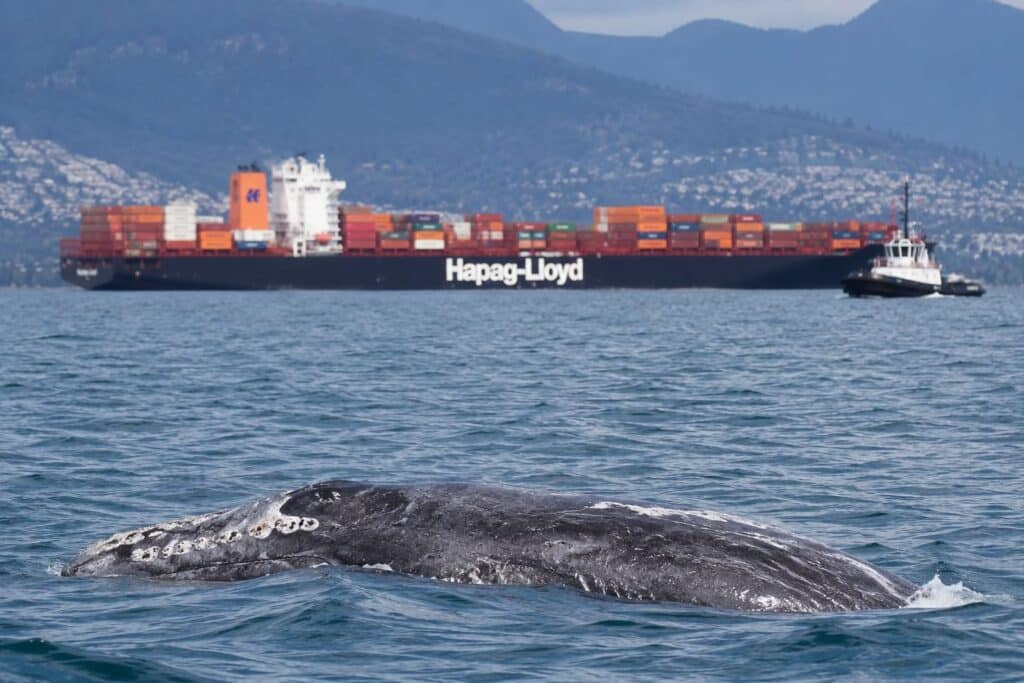
Seeing a 30,000 kg Grey Whale in Vancouver’s busy harbors feels like a magical local moment. But scientists are issuing a grim warning: these giants aren’t here to put on a show. They are starving, desperate, and playing a deadly game of odds.
When it comes to recent Vancouver whale sightings, seeing a 30,000 kg Grey Whale breaching in our busy harbors often feels like a magical, once-in-a-lifetime local moment. But marine biologists and scientists are issuing a grim warning: these giants aren’t here to put on a show for us. They are starving, desperate, and playing a deadly game of odds.
If you live in British Columbia, you’ve probably seen the viral videos filling up your feeds. Majestic Grey Whales swimming near the Stanley Park seawall, surfacing alongside recreational kayaks, and navigating the extremely busy waters of the Salish Sea. While an increase in Vancouver whale sightings might feel like a massive conservation win—a hopeful sign that our marine populations are finally bouncing back—the reality is far more tragic. It is actually a massive red flag.
The Desperation Dive: Why Are They Coming So Close?
Whales naturally prefer the open ocean and safe, established migration routes along the Pacific coast. When you see a massive Grey Whale entering the chaotic, noisy, and highly industrialized waters of a major urban harbor, it is almost never out of natural curiosity. It is out of pure, heartbreaking desperation.
Marine biologists and researchers monitoring the Unusual Mortality Event (UME) via NOAA and DFO point to a deeply disturbing trend: changing ocean temperatures and collapsing marine food chains have left many of these giants severely malnourished. In a desperate search for absolutely anything to eat, these starving whales are abandoning their safe, deep-water routes and venturing into the shallow, highly trafficked waters of the harbor. They aren’t exploring the city; they are scavenging for survival.
The Social Media Rush: Exacerbating the Problem
One of the biggest issues with modern Vancouver whale sightings is the immediate social media effect. As soon as a video of a harbor whale goes viral on Instagram or TikTok, hundreds of enthusiastic locals grab their paddleboards, kayaks, and motorized pleasure craft, rushing out onto the water to get a closer look.
While the intention is usually harmless admiration, this sudden swarm of human activity creates immense stress for an already weakened animal. The noise pollution from dozens of boat engines echoing underwater can severely disorient them. When a starving whale is forced to constantly dive or change direction to avoid an incoming fleet of amateur photographers, it burns the precious few calories it has left—energy it desperately needs just to stay alive.
A Deadly Game of Odds: The 300% Threat
Vancouver’s ports are not a peaceful marine sanctuary; they are an active, industrial marine highway. With cargo traffic in the region surging and creating a 300% increase in heavy vessel traffic, the local waters are heavily congested with massive container ships, commercial ferries, and recreational boats.
Placing starving, exhausted whales into a narrow, busy channel with this level of industrial traffic is a recipe for disaster. The risk of fatal ship strikes has skyrocketed in recent years. These gentle giants, already weakened by a severe lack of food, are simply not fast or agile enough to dodge massive cargo ships navigating the tight harbor routes.
The 1,000-Meter Lifeline
The situation has become so incredibly critical that the government had to step in. Transport Canada has quietly dropped a massive new emergency regulation to protect these specific animals. While standard whale-watching distances used to be 200 to 400 meters, the new law strictly dictates an emergency 1,000-meter distance for these vulnerable populations.
This isn’t a friendly suggestion; it’s a legally binding safety measure by Transport Canada designed to give these starving animals a fighting chance to rest and navigate safely.
What Can We Do?
The next time a massive Grey Whale makes local headlines for swimming near the seawall, remember the grim reality of why it is actually there. If you are out on a boat, a paddleboard, or a kayak this summer, do not chase the viral photo. Respect the law and give them some serious space.
If you happen to witness any Vancouver whale sightings where the animal appears to be stranded, injured, or in obvious distress within the harbor, do not approach it. Instead, immediately report the sighting to the Ocean Wise Marine Mammal Rescue Centre so their professional response team can monitor the situation.
They don’t need an audience right now. They need to survive.
The concerns surrounding the Port Authority’s dredging project and underwater noise are no longer just theoretical. Just recently, these industrial risks were put on full display during the chaotic 4 Orcas Vancouver sightings deep inside the Burrard Inlet. Watching a pod of killer whales try to navigate through departing cruise ships and heavy harbor traffic is exactly why environmentalists are sounding the alarm on further industrial expansion.

Hi, I’m the creator behind It’s Time for Vancouver. As a local resident, I spend my weekends capturing the magic of the Pacific Northwest, whether that’s mapping out historic day trips, tracking down regional wildlife, or finding the perfect urban escape. My goal is to give you honest, actionable guides so you can make the absolute most of every season in this beautiful province.





Pingback: Whale Watching Vancouver: 3 Spots to See Orcas From the Shore
Pingback: Burrard Inlet Vancouver: 3 Big Risks of the New Dredging Project
Pingback: 4 Orcas: Vancouver Harbor Sighting Raises Serious Concerns