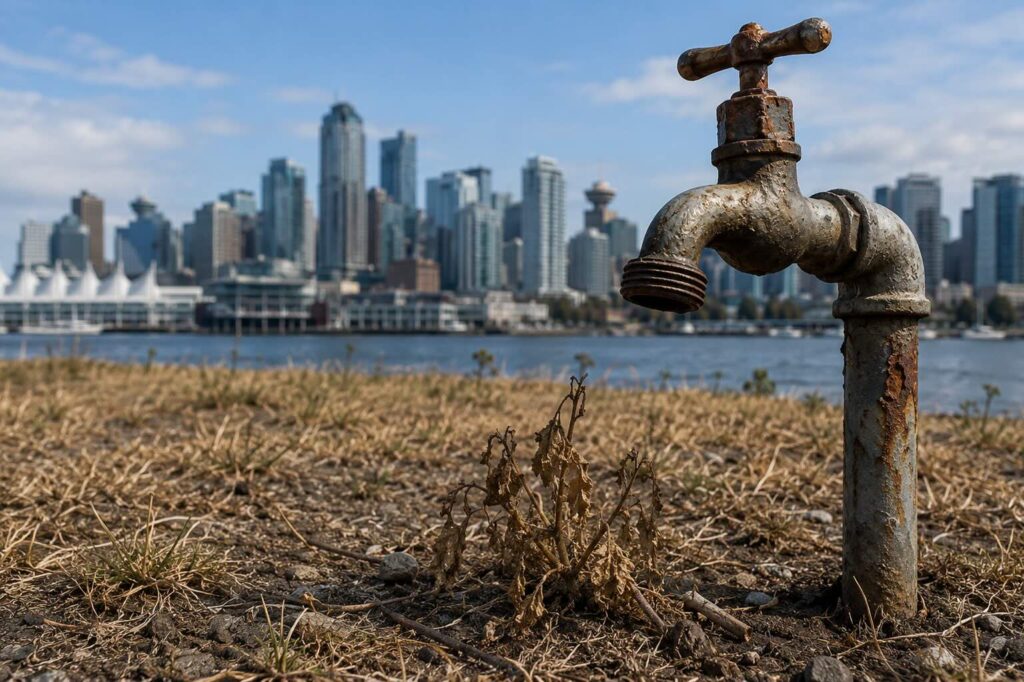
Shocked by the Vancouver water restrictions 2026? Uncover the hidden infrastructure failures behind the Stage 3 shortage and why Surrey is rebelling.
When you think of the Pacific Northwest, you picture lush greenery and endless rain. Unlike parts of California or Nevada that face systemic, multi-year droughts, Metro Vancouver is fundamentally a rainforest. Yet, as of June 8, the region has been plunged into severe Stage 3 regulations far earlier than usual.
If our reservoirs naturally refill and we live in one of the wettest climates on the continent, why are residents suddenly banned from topping up personal pools or washing their vehicles? If you are trying to make sense of the Vancouver water restrictions 2026, you must look beyond simple climate changes. It is a textbook case of municipal infrastructure bottlenecks and supply chain vulnerability.
We Are Not California: The True Cause of the Shortage
It is true that our region is facing an unusually dry summer, and the local snowpack—which acts as a slow-release frozen reservoir for the warmer months—is sitting at about half of its normal level. However, Metro Vancouver’s drinking water reservoirs were actually at typical seasonal levels entering the summer.
The real crisis is an urban planning and infrastructure bottleneck. Currently, the district is undertaking the massive Stanley Park Water Supply Tunnel project to replace a deteriorating water main built in the 1930s. To facilitate this complex construction, the First Narrows Crossing—one of the main supply pipes from the North Shore reservoirs to the city—has been entirely out of service since last fall.
This means a critical distribution artery is blocked. Water is a heavy commodity that must be moved efficiently, and much like the underwater construction challenges we analyzed in the Burrard Inlet expansion, the region is currently forced to rely heavily on just two water crossings instead of three. The Coquitlam water source is doing the heavy lifting, attempting to balance supply for the southern and western parts of the region while maintaining pressure for the Tri-Cities.
The 1.4 Billion Litre Red Line
Because the distribution network is severely constrained by the First Narrows shutdown, authorities have established a strict daily water use target of 1.4 billion litres to comply with the official drinking water conservation plan.
During a typical summer, regional water usage naturally jumps to 1.5 billion litres a day. With current infrastructure limits, exceeding the 1.4 billion litre mark is not an ecological threat; it is an operational one. If demand spikes during a heatwave, the system simply cannot push enough water through the remaining pipes fast enough. This would lead to a dangerous drop in water pressure across Port Moody, Coquitlam, Richmond, and Vancouver, potentially compromising the water supply for first responders during emergencies.
The Surrey Rebellion: A Data-Driven Defiance
While most municipalities have fallen in line, the City of Surrey made headlines by refusing to escalate beyond Stage 2. The Surrey City Council passed a bylaw allowing residents greater flexibility, including topping up small pools, watering newly planted lawns with permits, and letting power-washing businesses operate with handheld machines.
Regional leaders have expressed frustration, but Surrey’s defiance is firmly rooted in data and logistics:
-
Geographic Advantage: Surrey’s water demand is largely unaffected by the First Narrows water main shutdown that is bottlenecking Vancouver.
-
Lower Per Capita Consumption: According to the district’s own data, Surrey is actually highly efficient. Surrey residents consume approximately 301 litres per person per day. In contrast, Vancouver residents consume 379 litres, and Richmond sits at 390 litres. Statistically, Surrey is using over 20% less water per capita than Vancouver.
-
Real-Time Monitoring: Surrey’s utilities department actively monitors internal pressure and flow. Their data shows consumption trending downward, allowing them to provide flexibility to residents without threatening the regional network.
Because the regional district does not have the legal mechanism to force member municipalities to adopt restrictions outside of a declared emergency, the standoff remains a battle of strong words and localized bylaws.
The Bottom Line for Metro Vancouverites
The situation highlights a critical vulnerability in our region’s growth. We are not experiencing a California-level environmental drought; we are experiencing an infrastructure strain. Until the First Narrows Crossing is brought back online, every resident must conserve water not because the rain has stopped forever, but to ensure the physical pipes can maintain enough pressure to keep the city safe and functioning. If you want to escape the dry lawns and municipal drama, taking a transit-friendly day trip to New Westminster to sit by the river might be the best way to cool off this summer.

Hi, I’m the creator behind It’s Time for Vancouver. As a local resident, I spend my weekends capturing the magic of the Pacific Northwest, whether that’s mapping out historic day trips, tracking down regional wildlife, or finding the perfect urban escape. My goal is to give you honest, actionable guides so you can make the absolute most of every season in this beautiful province.