The City of Burnaby completed the new Metrotown scramble, but the massive transit intersection remains car-centric for Metro Vancouver commuters.
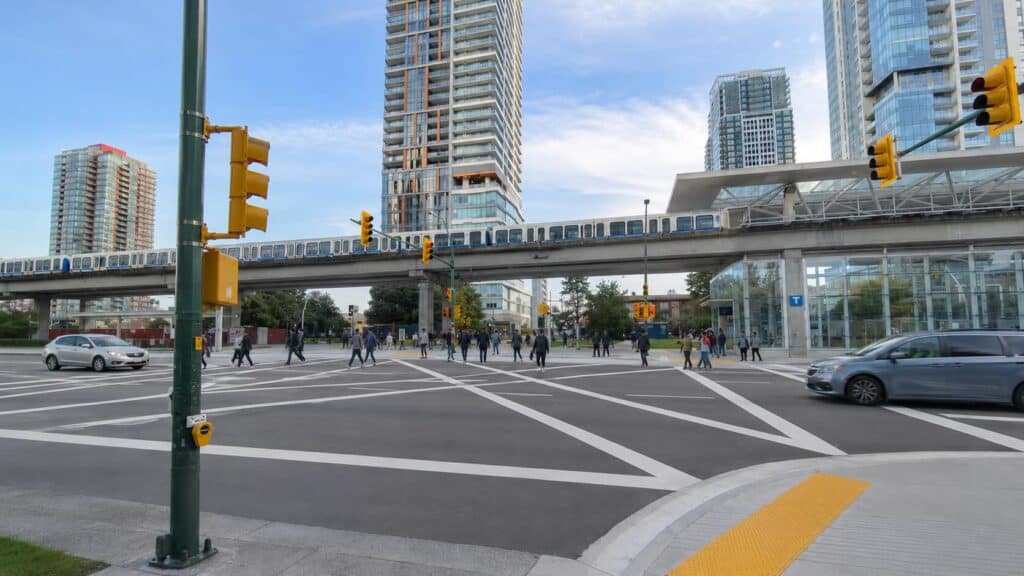
Pedestrians moving between transit infrastructure and retail hubs in the region have a new way to navigate one of the busiest intersections in Metro Vancouver. The City of Burnaby has officially opened a new five-way Metrotown scramble at the junction of Central Boulevard and the underground parkade entrance to Metropolis at Metrotown.
This configuration introduces diagonal crosswalks and a dedicated all-pedestrian signal phase. It completely stops all vehicle traffic to allow people to cross in any direction simultaneously.
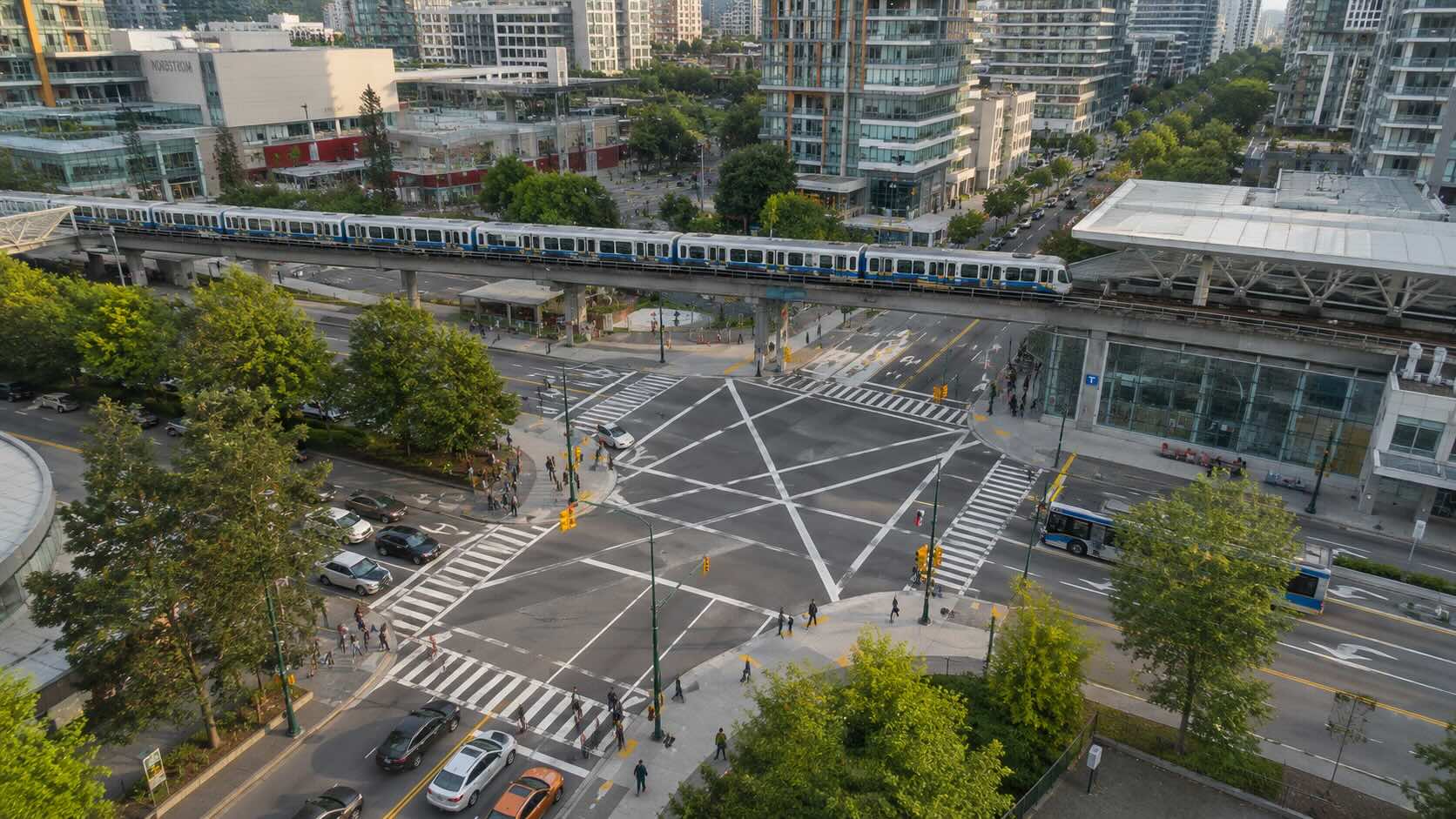
However, while the redesign is championed as a pedestrian accessibility upgrade, the reality on the ground highlights an ongoing struggle within Pacific Northwest urbanism. The intersection remains a massive expanse of asphalt. This means crossing the Metrotown scramble will likely take significantly more time for the average pedestrian waiting for the dedicated light phase.
Despite the new paint and crossing patterns, the sheer scale of the intersection ensures that the automobile remains the undisputed focus of the urban layout. Foot traffic is left to navigate a fundamentally car-centric environment, falling short of creating a truly human-scaled, pedestrian-first public square.
Planners often utilize these traffic-stopping measures as a quick fix. Yet, true urban transformation requires minimizing lane widths, reducing speed limits, and reclaiming pavement for public plazas rather than merely painting new lines on an oversized street.
A Critical Transit Pinch Point
The area serves as an essential artery for local commuters and international shoppers alike. According to official 2024 statistics from TransLink, Metrotown Station recorded 8.51 million boardings. This makes it the second-busiest hub on the SkyTrain network.
To accommodate the massive daily influx from the adjacent bus exchange and the shopping center, the recent street-level redesign eliminated a small triangular traffic island at the northeast corner. Extending the sidewalk reduces the need for a tedious two-stage crossing.
The implementation of the Metrotown scramble joins a short, alphabetically sorted list of other pedestrian scrambles currently operating across British Columbia:
-
Downtown Vancouver (the intersection of Granville and Robson streets)
-
Richmond (the historic Steveston Village)
The Overpass Debate and Future Urbanism
For nearly a decade, commuters have been forced to cross at street level due to the 2016 disconnection of the original elevated pedestrian walkway. The overpass was severed to accommodate significant renovation and expansion work at the station.
While the new street-level Metrotown scramble manages current foot traffic volumes, it is not intended to be a permanent substitute for a direct, grade-separated connection.
Future urban planning discussions are tied closely to the massive property redevelopment envisioned by mall owner La Caisse. The ownership group has been preparing a long-term master plan. This aims to transform the sprawling retail center into a high-density, mixed-use district featuring new residential, commercial, and public spaces.
A crucial first step for any future pedestrian overpass—which would connect directly to the newer mezzanine entrance built in 2018—requires the demolition of the disconnected, older structure. City staff confirmed recently that they are actively exploring demolition options. The eventual removal of the concrete eyesore will pave the way for a more seamless integration between the rapid transit network and the commercial district.
Beyond the Intersection: Active Transportation
Meanwhile, the regional transit authority is eyeing broader infrastructural upgrades. Planned improvements for the overall bus exchange include spatial adjustments to the BC Parkway located immediately south of the station. This 26-kilometer (16.1-mile) multi-use path is a vital corridor for cyclists and pedestrians, linking multiple municipalities.
Expanding this area would aim to boost capacity, building upon the 2018 upgrades that first introduced on-street bus bays outside of the main loop. By integrating these future corridor enhancements with the new Metrotown scramble, urban planners hope to eventually weave a more cohesive, less vehicle-dominated fabric. However, until the massive footprint of the primary boulevard is addressed, true walkability remains a distant goal.
As the City of Burnaby and regional transit authorities continue to navigate the friction between rapid growth and pedestrian accessibility, the new Metrotown scramble serves as both a milestone and a stark reminder of the work left to do. Will this diagonal crossing inspire bolder urban interventions across Metro Vancouver, or is it simply a temporary patch on a fundamentally car-centric design?
Join the Conversation
What are your thoughts on the new intersection at Metropolis at Metrotown? Does this redesign truly improve your commute, or does the scale of the asphalt still favor the automobile?
For more daily insights into Pacific Northwest urbanism, transit infrastructure updates, and deep dives into the local lifestyle, follow us on Instagram at @itstimeforvancouver. Join the growing community and stay connected as we continue to track the rapid evolution of British Columbia’s cities.

Hi, I’m the creator behind It’s Time for Vancouver. As a local resident, I spend my weekends capturing the magic of the Pacific Northwest, whether that’s mapping out historic day trips, tracking down regional wildlife, or finding the perfect urban escape. My goal is to give you honest, actionable guides so you can make the absolute most of every season in this beautiful province.